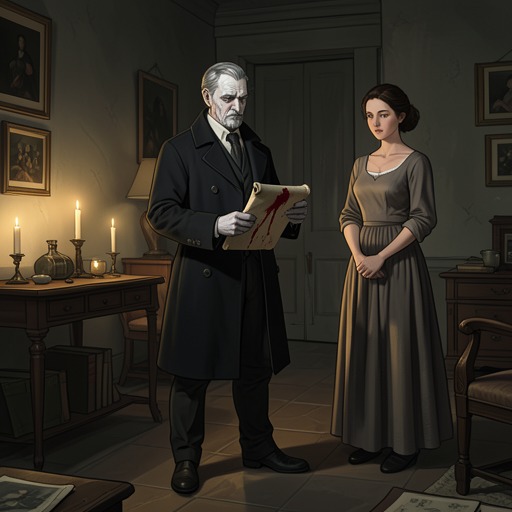
Manfred
The Castle of OtrantoManfred, Prince of Otranto, is both the defender of a hereditary claim and the ruler whose efforts to preserve it expose its criminal foundations. Hoping to secure a male successor through his son Conrad’s marriage to Isabella, he instead tries to marry Isabella himself after Conrad dies. His insistence on possession and succession culminates in the mistaken killing of his daughter Matilda; the supernatural recognition of Theodore as Alfonso’s heir then compels Manfred to confess his family’s usurpation, surrender the principality, and withdraw with Hippolita to a religious house.
Identity and Dynastic Position
Manfred rules Otranto through a title he says passed to him from his father, Don Manuel, and before him from his grandfather, Don Ricardo. In his public account, Alfonso died without children in the Holy Land and bequeathed his estates to Ricardo in recognition of his faithful service. The competing claim, however, is that Frederic is the nearest blood relative of Alfonso, and that Manfred’s family has retained the principality by force rather than lawful succession. The distinction between holding power and having a rightful title defines Manfred’s political predicament from the beginning.
His household is organized around the same pressure of succession. Manfred has a son, Conrad, and a daughter, Matilda, but favors Conrad and displays no comparable affection for Matilda. Conrad is sickly and three years younger than his eighteen-year-old sister; nevertheless, Manfred has arranged his marriage to Isabella, whose guardians have brought her to Otranto. Manfred’s impatience to celebrate the match is noticed by his family and subjects. Hippolita objects that their son is very young and infirm, but Manfred answers by reproaching her for having given him only one heir. His response makes clear that he treats marriage and fertility as dynastic necessities, not private matters.
Marriage, Authority, and Political Calculation
After Conrad’s death, Manfred turns the alliance intended for his son into a proposal to Isabella for himself. He tells her that she has lost a husband unworthy of her and offers himself in Conrad’s place. When she appeals to her grief and asks to remain under his roof until her father returns, Manfred insists that Hippolita is no longer his wife and declares that he will divorce her. He says his fate depends on having sons, and presents a new marriage as the means to renew his hopes of an heir. Isabella’s appeal to the household’s hospitality and her affection for Hippolita and Matilda does not restrain him.
The proposal is also part of Manfred’s calculation over the rival claims of Otranto and Vicenza. He had secured Isabella from her guardians while Frederic was absent, intending the marriage to Conrad to unite the claims of the two houses. Once Conrad is dead, Manfred’s own proposed marriage continues that strategy. When Frederic’s champion arrives demanding Isabella’s return and Manfred’s surrender of Otranto, Manfred recognizes that Frederic’s claim is well founded. He nevertheless insists on defending the title and argues that Ricardo received the principality by Alfonso’s bequest. The challenge forces Manfred to set out the official account of his inheritance while revealing how much his authority depends on a contested history.
Manfred’s response to the challenge combines the language of chivalry with political self-preservation. He offers the visiting knights courteous reception and safe conduct, while trying to avoid provoking Frederic before the dispute can be addressed. His hospitality is therefore not separate from his claim to rule: it is a means of managing a dangerous confrontation while protecting his position and concealing Isabella’s flight from the knight’s retinue.
Family Relationships and Misjudgment
Manfred’s relationship with Hippolita is marked by his contempt for her inability to provide more heirs and by her continued concern for the family he is willing to discard. Even after he declares their marriage ended, Hippolita seeks a way to avert the household’s destruction. Convinced by the events of the preceding days that Otranto will pass from Manfred, she proposes a union between the rival houses by offering Matilda in marriage to Frederic. Manfred listens favorably and goes to tell Frederic. The proposal shows Hippolita attempting to turn marriage toward reconciliation, in contrast to Manfred’s use of it to secure his own succession.
Manfred’s suspicion also distorts his understanding of Matilda. When Bianca mentions Theodore and says that he resembles Alfonso, Manfred becomes agitated and demands to know when Isabella first met Theodore. His questions focus on Isabella, but his later actions show how readily he converts uncertainty into jealous assumption. At the church, he mistakes a voice in the darkness for Isabella speaking of a union with Theodore. His belief that he is preventing that union determines the blow he strikes, though the person he attacks is Matilda.
The mistake exposes the distance between Manfred’s declared authority and his actual control over events. Matilda had gone to the tomb of Alfonso not to meet Theodore, but to pray there for Manfred and Hippolita at her mother’s request. As she is dying, she asks Manfred to forgive her, assures him that she forgives him, and pleads with him not to put Hippolita away. Her last concerns are for her parents and for the people she leaves behind. Manfred, by contrast, can only recognize that his own rage has destroyed the daughter whose affection he had neglected.
Confession and Abdication
When Manfred reaches the company carrying Matilda, her death becomes clear to him. The castle then shakes, its walls are thrown down, and the apparition of Alfonso appears in the ruins. It declares Theodore the true heir. The assembled witnesses acknowledge the supernatural pronouncement, while Hippolita tells Manfred that Conrad is gone, Matilda is dead, and Theodore is the true Prince of Otranto. For Manfred, the declaration turns the question of succession from a dispute among human claimants into an explicit judgment against his rule.
Manfred accepts that judgment and confesses the concealed crime behind his family’s title. Alfonso did not die naturally: Ricardo, Manfred’s grandfather and Alfonso’s chamberlain, poisoned him, then used a fictitious will to claim the inheritance. Manfred says that Ricardo’s guilt was followed by a promise to Saint Nicholas: if he survived a storm and reached Otranto, he would found a church and two convents. The saint appeared in a dream and promised that Ricardo’s descendants would rule until the rightful owner grew too large to inhabit the castle, provided Ricardo’s male line continued. Manfred identifies the loss of Conrad and Matilda, and the extinction of the family’s remaining male and female line except himself, as the price of that usurpation.
Manfred does not claim to understand how Theodore is Alfonso’s heir, but says he no longer doubts the revelation. He resigns the dominions and describes confession as the only satisfaction he can offer for usurpation and the killing of his child in a consecrated place. In the morning, with Hippolita’s approval, he signs his abdication. He and Hippolita take religious habits in neighboring convents, exchanging political rule for a life of religious retreat.
Narrative Role and Ending
Manfred’s arc makes dynastic ambition turn inward: the measures he takes to preserve his house instead expose its illegitimate origin and destroy the family he means to command. Conrad’s intended marriage to Isabella, Manfred’s attempt to replace his son as bridegroom, and Hippolita’s proposed match between Matilda and Frederic are all efforts to shape succession through marriage. Yet none can settle the claim. The decisive evidence comes through confession and Alfonso’s apparition, which names Theodore as heir and makes Manfred’s renunciation the final political consequence of the family secret.
The ending does not restore Manfred’s household. Conrad and Matilda are dead, and Manfred and Hippolita withdraw from public life. Frederic offers Isabella to Theodore, but Theodore’s grief for Matilda is too fresh for him to accept another love immediately. Only after repeated conversations with Isabella about Matilda does he come to believe that happiness may be possible in her company, while continuing to mourn. Manfred’s surrender thus establishes the rightful succession without undoing the personal losses that brought his rule to an end.